
What Are Xenon Headlights?
When people ask what are xenon headlights, they are usually asking about a type of HID lighting fitted to a vehicle. Unlike a conventional halogen bulb, a xenon lamp has no filament that glows when heated. Instead, it creates light through…
What xenon headlights are
When people ask what are xenon headlights, they are usually asking about a type of HID lighting fitted to a vehicle. Unlike a conventional halogen bulb, a xenon lamp has no filament that glows when heated. Instead, it creates light through an electrical arc inside a sealed gas-filled capsule. The result is generally a bright, white light with a slightly blue appearance.
The meaning of xenon headlights and HID lights
Xenon headlights are commonly called HID headlights because HID stands for High-Intensity Discharge. The name describes the way the lamp produces illumination: electricity discharges between two electrodes inside the bulb. Xenon gas helps the discharge start and provides light while the system reaches its normal operating condition.
The term “xenon” can also be used loosely for bulbs that contain xenon gas but still use a filament. Those are not the same as automotive HID systems. In a true xenon headlight, the bulb, ignition equipment and ballast work together as one lighting system.
How xenon headlights differ from halogen bulbs
A halogen headlight sends current through a tungsten filament, heating it until it glows. The design is relatively simple, which helps keep purchase and replacement costs down. Xenon lighting instead uses an arc, so it needs additional electrical components and normally takes a short time to reach full output.
The visual difference is often noticeable. Halogen light tends to look warmer and more yellow, while xenon light is usually whiter. Brightness and beam quality still depend on the reflector or projector, bulb condition and alignment, rather than the bulb type alone. This xenon and halogen comparison explains the practical differences in more detail.
The role of xenon gas in the lighting system
Xenon is an inert gas that conducts electricity when it has been ionised. Inside the lamp, the gas supports the arc between the electrodes and helps produce intense visible light. Other materials may also be present in the bulb, but xenon is central to the quick creation of the discharge.
It is not the gas burning like a fuel. The light comes from the electrical energy passing through the ionised gas. Once the arc is established, the ballast regulates the supply so the lamp can operate steadily without an uncontrolled current increase.
Where xenon headlights are commonly used
Xenon headlights were widely fitted to higher-specification cars, particularly before LED systems became more common. They may appear as dipped-beam lights, main-beam lights or part of an adaptive lighting arrangement, depending on the vehicle. Factory systems are designed around a particular lamp, housing and control arrangement.
A vehicle advertised with a premium lighting package may therefore have xenon lamps alongside other lighting technologies. The safest way to identify them is to check the handbook, bulb marking or vehicle specification rather than judging by colour alone.
How xenon headlights work
A xenon headlight passes through several stages before it produces its normal light output. The system must create a high-voltage start, establish a stable arc and then control the electrical supply as the lamp warms. That is why a xenon headlight is more than a bulb fitted into a socket.

The xenon arc and electrical discharge
The bulb contains two electrodes separated by a small gap and surrounded by xenon gas. A high-voltage pulse creates a spark across that gap, ionising the gas and allowing current to flow. This produces the arc that gives the lamp its characteristic bright light.
At first, the discharge is not fully stable. As the lamp warms, the gas and any other internal materials reach operating conditions, changing the way the arc behaves. The light then settles into a more consistent output.
The function of the ballast
The ballast is the electronic unit that manages the lamp’s electrical demands. It provides the high-voltage pulse needed for ignition, then changes to a controlled supply suitable for continuous operation. Without that regulation, the lamp could not start or run safely in the intended way.
A ballast can also monitor the system and shut it down when it detects certain faults. The xenon ballast guide covers ignition, power control and protective functions without treating the bulb as an isolated component.
Several parts must work together during operation:
- The ignition circuit creates the initial high-voltage pulse.
- The ballast limits and controls current after the arc starts.
- The bulb electrodes sustain the electrical discharge.
- The headlight optics shape the resulting light on the road.
This sequence explains why replacing only a bulb may not fix a headlight that remains dark. A fault in the ballast, wiring or control equipment can produce similar symptoms.
Why xenon headlights need an ignition system
The arc cannot be created by the vehicle’s ordinary low-voltage supply alone. The ignition system briefly raises the voltage high enough to bridge the gap between the electrodes. Once the gas is ionised and the arc is established, the system can move into its normal operating phase.
That initial voltage is potentially dangerous, which is one reason xenon headlight work should not be approached like a routine halogen bulb change. The ignition stage also explains why a failing system may flicker, attempt to start repeatedly or switch off soon after lighting.
How the light reaches full brightness
Xenon lamps usually take a short period to warm up. They can produce light quickly, but the colour and intensity change as the arc reaches a stable operating temperature. The ballast adjusts the supply during this period and then maintains the lamp at its designed operating level.
The delay is most obvious when switching the lights on from cold. A system that takes noticeably longer than usual, changes colour or repeatedly cuts out may need professional diagnosis rather than a simple visual inspection.
The benefits of xenon headlights
Xenon headlights became popular because they offered a strong beam from relatively compact lamps. For drivers who regularly use unlit roads, the difference from older halogen systems can be useful. However, the benefit comes from the complete lamp and optical design, not from xenon gas alone.
Brighter illumination and improved visibility
A properly designed xenon system can provide more intense illumination than a comparable halogen headlight. That may make road edges, bends and hazards easier to see at night. The improvement is most useful when the beam is correctly aimed and the lens is clean.
Brightness should not be confused with better visibility in every situation. Excessive glare, dirty lenses or poor beam control can reduce the benefit for other road users and may make the driver’s own view less comfortable in rain or mist.
A wider and longer light beam
Many xenon headlights are paired with projector or reflector designs that create a broad, carefully shaped beam. This can illuminate more of the carriageway and extend useful visibility further ahead. The actual pattern varies significantly between vehicles, so two xenon-equipped cars may not perform identically.
A longer beam is only helpful when it remains within the legal and intended aiming range. Automatic levelling, where fitted, helps compensate for changes in vehicle load and reduces the chance of the lamps pointing too high.
Lower energy consumption than halogen lights
Xenon systems can use less electrical power than some halogen arrangements while producing a strong level of illumination. That can reduce the load placed on the vehicle’s electrical system during normal operation. The ballast itself consumes energy, so the comparison should consider the complete system rather than the bulb rating alone.
Drivers comparing technologies may find this xenon and LED headlights guide useful because energy use, brightness, lifespan and replacement practicalities all matter together. A lower power figure does not automatically make one system the right choice for every car.
Longer bulb life in normal conditions
Xenon bulbs often last longer than traditional halogen bulbs when operated in normal conditions. Their lack of a fragile filament removes one common failure point. Even so, age, vibration, repeated switching and problems elsewhere in the headlight can shorten their useful life.
A gradual colour change is often an early warning that a bulb is nearing the end of its service life. Replacing it before complete failure can avoid being left with reduced lighting on one side of the vehicle.
The drawbacks of xenon headlights
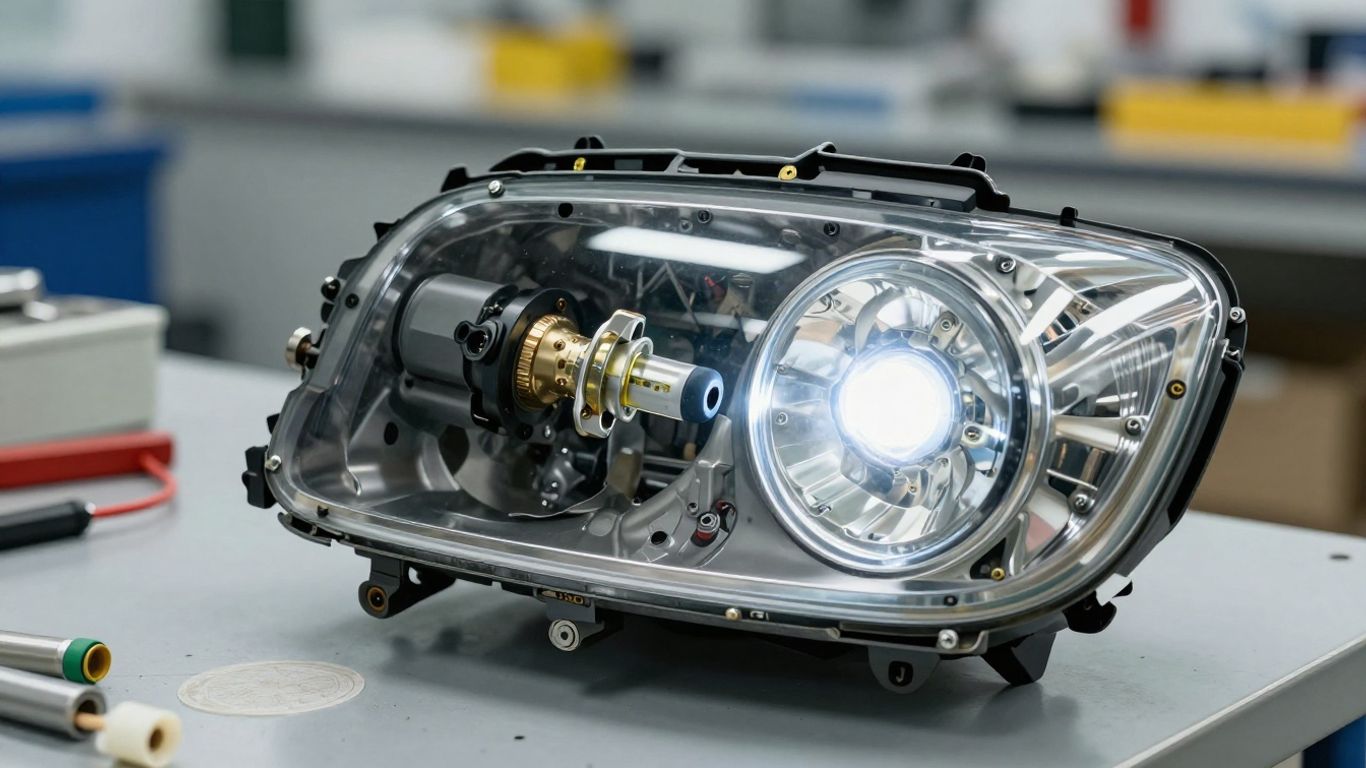
The extra hardware that makes xenon lighting effective also makes it more complicated. Bulbs, ballasts, wiring and control units can all contribute to the final repair cost. A fair assessment therefore includes ownership and installation issues, not just the brightness seen from the driver’s seat.
Higher purchase and replacement costs
Xenon bulbs generally cost more than standard halogen bulbs, and the system may need specialist diagnosis. If the ballast or igniter has failed, installing a new bulb alone will not solve the problem. Labour can also be higher where access to the headlight is restricted.
The most sensible approach is to identify the fault before buying parts. A quote should distinguish between a bulb, ballast, wiring or complete headlight issue, as these repairs can have very different prices.
Warm-up time and changing light output
Unlike an LED, a xenon lamp does not normally reach its final colour and intensity instantly. It may appear slightly dimmer or different in colour for a short time after being switched on. Repeated rapid switching can also place additional stress on the ignition equipment.
A small change during warm-up is normal, but pronounced flickering or a lamp that repeatedly goes out is not. Those symptoms may point to a weakening bulb, unstable ballast or a poor electrical connection.
Glare risks from incorrect alignment
A bright headlight can become a nuisance or a safety hazard if it is aimed too high. Incorrect conversion parts, damaged suspension, a heavy load in the boot or a faulty levelling system can all alter the beam position. Glare is particularly uncomfortable on dark, wet roads.
Correct alignment is therefore part of responsible xenon ownership. The beam should be checked after headlight work and whenever the vehicle’s ride height or mounting position has changed.
Potential faults in ballasts and control units
Electronic components can fail through age, water ingress, heat or wiring damage. Common signs include intermittent operation, delayed ignition, flickering or a headlight that works only after several attempts. Fault codes may be stored even when the problem is not immediately visible.
A proper diagnosis should test the bulb and the supporting electronics. Swapping parts at random can be expensive and may conceal an issue that will soon affect the replacement component.
Xenon headlights compared with other technologies
There is no universal winner among halogen, xenon, LED and laser headlights. Each technology has different requirements, costs and strengths, while the vehicle’s optics and software affect the result. The best comparison considers real driving conditions and the condition of the particular system.
Xenon versus halogen headlights
Halogen headlights are mechanically simple, widely available and usually inexpensive to replace. Xenon systems generally provide a whiter, more intense beam and may last longer, but they need a ballast and ignition equipment. That added complexity is the main trade-off for the extra output.
For an older car with basic lighting, a good halogen system can remain perfectly serviceable. A factory xenon system may be preferable for frequent night driving, provided its components are in good condition and its beam is correctly aligned.
Xenon versus LED headlights
LED headlights create light through semiconductor components rather than a gas discharge. They can switch on instantly, use little energy and allow compact designs with precise control. Xenon lamps can still offer strong illumination, but they have a warm-up period and more components that may require replacement.
The comparison is not only about brightness. Repairability, replacement cost, heat management, adaptive functions and the design of the original headlight all influence the sensible choice. Converting one technology to another is not automatically an upgrade.
Xenon versus laser headlights
Laser headlights are a specialised technology associated with advanced lighting systems and are not a straightforward replacement for xenon bulbs. They use laser light sources alongside other components and require carefully engineered optics and control systems. Their availability is limited compared with halogen, xenon and LED equipment.
For most motorists, the meaningful decision is between the system already engineered for the car and a compliant replacement. The headline technology matters less than beam performance, reliability and correct installation.
Which headlight type suits different driving needs
Someone who mainly drives in towns may be satisfied with well-maintained halogen or LED lighting. A driver covering rural roads may value the reach and intensity of a good xenon or LED system. Vehicle age, repair budget and access to approved parts should also shape the decision.
When choosing a car, lighting is one detail among many. For example, a Volvo XC60 may appeal to a driver weighing comfort, vehicle practicality and ownership arrangements alongside equipment. First Flexi Lease offers flexible vehicle leasing solutions, so the lighting package can be considered as part of the wider vehicle choice rather than in isolation.
Retrofitting xenon headlights to a car
Retrofitting xenon headlights is more involved than fitting a different bulb into the original holder. The housing, wiring, ballast, beam pattern and vehicle control systems all need to be compatible. A conversion that appears bright in a driveway may still create glare or fail a roadworthiness check.
Whether a xenon conversion is compatible
Start by checking the exact vehicle model, headlight housing and approved bulb type. The original reflector or projector may not be designed to control the shape and intensity of a xenon arc. Space, connectors, power requirements and dashboard fault monitoring can also affect compatibility.
The conversion should be assessed as a complete system. If the housing cannot form the correct dipped-beam pattern, a brighter lamp will not make the installation safe or compliant.
Factory-fitted systems versus aftermarket kits
Factory-fitted xenon systems are designed around the car’s optics, wiring and control equipment. Aftermarket kits vary in quality and may not provide the same beam control or electrical integration. They can also leave the owner with difficult faults if the vehicle’s original electronics do not recognise the new load.
A replacement headlight assembly approved for the specific vehicle is generally a more controlled route than mixing unrelated parts. First Flexi Lease can help customers consider vehicles with their existing equipment and fixed package terms, rather than encouraging modifications to a car that was not designed for them.
Headlight washers and automatic levelling requirements
Some xenon-equipped vehicles use headlight washers and automatic levelling to keep the beam controlled when the lens is dirty or the vehicle is carrying a changing load. Whether these features are required depends on the vehicle, headlamp approval and applicable rules. They should not be treated as optional decoration.
Before fitting a system, check the requirements for the specific car and lamp. A qualified technician can confirm whether sensors, washers, wiring and calibration are needed, and whether the finished beam meets the correct pattern.
UK legal and roadworthiness considerations
UK requirements can depend on the age and approval of the vehicle and the exact lighting arrangement. Dipped beams must be correctly aimed, securely mounted and free from faults that affect performance. An unsuitable conversion may fail an MOT or cause problems during a roadside inspection.
Keep records of the parts fitted and have the lamps checked after installation. If there is uncertainty, advice from an MOT tester or vehicle lighting specialist is more reliable than relying on a generic online kit description. Drivers can also explore flexible options when choosing a vehicle that already has the equipment they need.
Maintaining and replacing xenon headlights
Good maintenance begins with noticing small changes in light output. Xenon lamps often deteriorate gradually rather than failing without warning, while electronic faults can appear intermittently. Keeping both lenses clean and checking the beam regularly helps separate a lighting problem from a visibility problem caused by dirt or weather.
Signs that a xenon bulb needs replacing
A bulb may be approaching the end of its life if it flickers, takes longer to start, appears weaker or produces a pink, purple or noticeably different colour. One side may also look dimmer than the other. These signs can overlap with ballast or wiring faults, so testing is still worthwhile.
Do not assume that a dark lamp has failed permanently until the supporting circuit has been checked. A diagnostic inspection can prevent an unnecessary bulb purchase and identify a fault that could damage the replacement.
Why xenon bulbs change colour before failing
The electrodes wear as the arc operates, gradually changing the conditions inside the bulb. Deposits and altered gas behaviour can make the light look less white and more violet or pink. This colour shift is often a useful warning that the lamp is ageing.
The change may be subtle at first, especially in daylight. Comparing both headlights after dark can reveal a difference that is not obvious from a quick glance at the front of the car.
Replacing bulbs in pairs
Replacing both bulbs at the same time can keep the colour and intensity more closely matched. Even if only one lamp has failed, the other may have accumulated a similar amount of use and could change colour soon afterwards. Pair replacement is not an absolute rule, but it is often a practical choice.
Use the correct specification for the vehicle and avoid touching the glass portion of the bulb. After installation, both lamps should be checked for operation, beam position and any warning messages.
Safety precautions when working with high-voltage systems
Xenon ignition circuits can generate high voltage, including after the lights have been switched off. Do not unplug the bulb or ballast while the system is energised, and follow the vehicle manufacturer’s isolation procedure. Moisture, damaged insulation and improvised wiring add further risk.
For most drivers, professional replacement is the sensible option. A technician can isolate the circuit, fit the correct component and confirm that the headlight is operating safely before the car returns to the road.
Conclusion
Xenon headlights use an electrical arc in xenon gas to produce powerful, white illumination, supported by a ballast and ignition system. They can improve night-time visibility and last longer than halogen bulbs, but their cost, warm-up behaviour and high-voltage hardware deserve careful attention. Whether maintaining an existing system or choosing a different car, compatibility, beam alignment and legal compliance matter as much as brightness.
Frequently asked questions
Are xenon headlights the same as HID headlights?
Do xenon headlights use a filament?
Do xenon headlights come on instantly?
Are xenon headlights brighter than halogen headlights?
Can any car be converted to xenon headlights?
How long do xenon bulbs usually last?
Should xenon bulbs be replaced in pairs?
Reviewed by
Billy Lang, Director
FCA Registration No: 835008
Keep reading
Related guides
Vehicle guides
Are 1.0-litre turbo engines any good?
How three-cylinder 1.0 turbo engines manage the pace of a bigger engine on small-car running costs, where they struggle, and which ones have proven themselves.
Read guideVehicle guides
Audi A1: Perfect First Car
The Audi A1 can make a polished, manageable first car, but the right example matters more than the badge. Think carefully about insurance, servicing, space and the condition of any used model before committing. Compact dimensions make the A1 comfortable in town and easier to park. The premium cabin and technology are appealing,…
Read guideVehicle guides
Are Alfa Romeo Cars Reliable?
Whether Alfa Romeo cars are reliable depends less on the badge alone and more on the model, engine, age and care it has received. Newer Alfa Romeo models can be enjoyable and dependable when serviced correctly. Electrical warnings, battery issues and wear to suspension components are common ownership concerns. A complete service history…
Read guideReady when you are
Put the reading into practice.
A soft credit check via Creditsafe takes minutes. It does not normally affect your credit score the same way as a full lending application — and you get an honest answer either way.
Request a Flexi Quote
Quick form. Tell us which flexi stock you are interested in and we'll call you back the same day.
