
Flagship Models by Manufacturer
The phrase “flagship model” describes a vehicle intended to express the highest level of a manufacturer’s design, engineering or equipment. It may be the largest car in a range, the most expensive, the most technologically ambitious, or…
What makes a model a manufacturer’s flagship
The phrase “flagship model” describes a vehicle intended to express the highest level of a manufacturer’s design, engineering or equipment. It may be the largest car in a range, the most expensive, the most technologically ambitious, or simply the model with the strongest connection to the brand’s identity. A useful flagship vehicle guide is therefore best read as a starting point rather than an absolute ranking.
The distinction matters because manufacturers do not all organise their ranges in the same way. One may place its emphasis on a long-wheelbase saloon, while another uses a luxury SUV, an electric grand tourer or a low-volume sports car to make its statement. The result is a broad and sometimes subjective group of vehicles.
Flagship, halo and luxury models explained
A flagship is normally the range-topping model in a particular part of a manufacturer’s line-up. A halo car is slightly different: it is designed to attract attention to the whole brand, even if it sells in tiny numbers or sits outside the normal range structure. A luxury model may be defined by its materials, space and price, but it is not automatically the brand’s flagship.
These categories often overlap. A large executive saloon can be a flagship and a halo car at the same time, while a supercar may be a halo vehicle without being the manufacturer’s practical range-topper. The safest comparison is to ask what job the model performs in its maker’s portfolio.
How manufacturers define their range-topping model
Manufacturers may define the top of their range through size, price, power, passenger space or technological ambition. Some use a formal hierarchy, with one model clearly above the others. Others have several flagships, each serving a different purpose, such as a saloon for chauffeur comfort and an SUV for family practicality.
There is also a difference between a current flagship and a historically important one. Model names change, production ends and new electric vehicles appear, so lists need to be understood in context. A car can remain culturally significant even when it is no longer sold new.
Saloon, SUV, sports car and electric flagships
The classic flagship is often a large saloon, shaped around quiet long-distance travel and generous rear-seat space. SUVs have broadened the category by offering a higher driving position, greater load-carrying ability and, in some cases, three rows of seats. Sports cars approach the role from another direction, using performance and design to define what the manufacturer can achieve.
Electric flagships add another layer. A large battery platform can provide strong acceleration, a calm cabin and a different interpretation of luxury, while charging speed and real-world range become part of the model’s status. None of these body styles is automatically superior; each reflects a different idea of what a top-of-the-range vehicle should do.
Why a flagship model may not be the brand’s best-selling car
Flagships are often expensive, large and built for a narrower audience than compact hatchbacks or family SUVs. Their role may be to set a design direction, introduce equipment or strengthen a manufacturer’s reputation rather than generate the greatest number of registrations.
That is why popularity is a poor test of flagship status. A best-selling model succeeds by meeting common needs at a widely acceptable price, while a flagship is usually judged by how convincingly it expresses the brand. For buyers, that distinction helps separate genuine range-topping credentials from simple commercial success.
Flagship models from European manufacturers
European manufacturers have a long tradition of using executive saloons and grand touring cars as their public statement. The region’s flagship models range from discreet long-distance cars to imposing SUVs and high-performance electric vehicles. They also show how much a manufacturer’s history influences its definition of luxury.
The examples below are not a single league table. They are a guide to the roles these vehicles commonly play, with some names current, some evolving and some retained mainly for their historical importance.
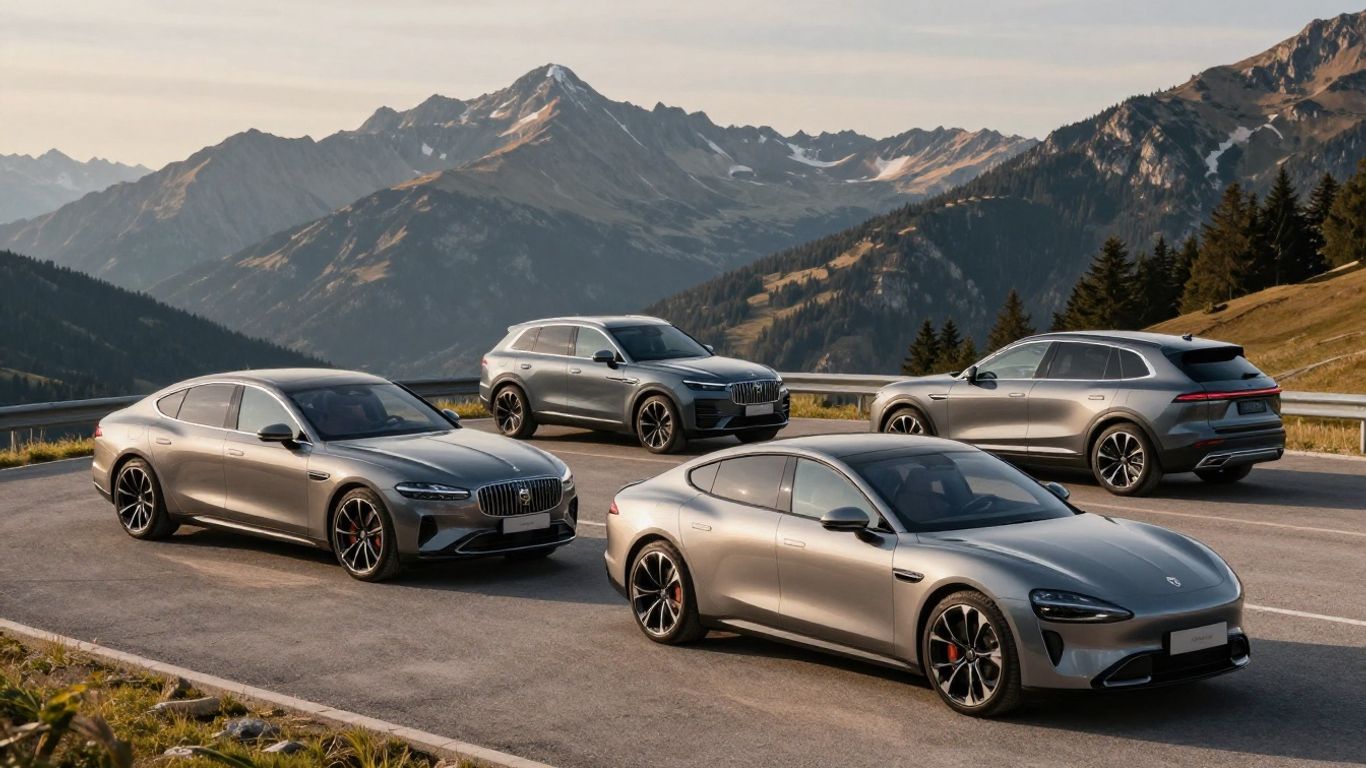
BMW 7 Series, Mercedes-Benz S-Class and Audi A8
The BMW 7 Series, Mercedes-Benz S-Class and Audi A8 are familiar examples of the traditional executive flagship. Each is associated with a spacious cabin, strong refinement and a high level of equipment, while their characters differ: the 7 Series is commonly linked with a driver-focused identity, the S-Class with formal luxury and the A8 with understated technology.
Their importance extends beyond individual specifications. These cars have often acted as showcases for cabin design, assistance systems and powertrain development before related ideas reach less expensive models. For buyers considering a Mercedes-Benz leasing option, the wider Mercedes-Benz range may be more relevant than the flagship itself, particularly where size and running costs matter.
Porsche Panamera, Taycan and Cayenne
Porsche has several plausible candidates for flagship status because its range is divided by body style and purpose. The Panamera brings grand touring ability to a four-door format, the Taycan places an electric performance car at the centre of the brand’s modern technology story, and the Cayenne gives the manufacturer a large, high-performance SUV.
Rather than choosing one universal winner, it is more useful to see these models as different expressions of the same premium performance brief. The Panamera suits buyers who want a long-distance car with sporting intent, the Taycan appeals to those wanting electric performance, and the Cayenne prioritises versatility without abandoning pace.
Volvo EX90, Range Rover and Jaguar XJ
The Volvo EX90 illustrates the shift towards large electric SUVs as flagship products. Its role is connected with family space, a premium cabin and the broader move towards battery-powered vehicles. Range Rover occupies a different but equally recognisable position, combining luxury SUV presentation with a reputation for off-road capability and long-distance comfort.
The Jaguar XJ remains an important historical reference, even though its place in the modern range has changed. It shows that flagship status can endure as an idea after production ends, particularly when a model has become closely associated with a marque’s design language and executive-car heritage.
Volkswagen Touareg, Peugeot 508 and DS N°8
The Volkswagen Touareg demonstrates how a large SUV can sit above more mainstream models in perceived sophistication and equipment. The Peugeot 508 has represented the upper end of Peugeot’s passenger-car line-up, with a sleeker saloon and fastback interpretation of executive travel. DS N°8 brings the premium electric fastback idea into the discussion, reflecting a newer understanding of what a French flagship might be.
These examples also underline the importance of market context. A model may be positioned as a flagship in one country or body-style category without being the most expensive vehicle sold by a wider corporate group. Buyers should therefore check the actual UK range rather than relying on a label alone.
Flagship models from Asian manufacturers
Asian manufacturers have developed a particularly varied set of flagship ideas. Some retain formal saloons with long-standing cultural importance, while others place large electric SUVs or advanced battery vehicles at the top of their ranges. The result is a mixture of heritage, technology and changing customer expectations.
The category is especially fluid in electric vehicles. New names can move quickly from specialist interest to serious luxury contenders, while established manufacturers continue to preserve distinctive models for domestic or ceremonial markets.
Toyota Century, Lexus LS and Nissan GT-R
The Toyota Century is associated with formal Japanese luxury and a highly traditional presentation. The Lexus LS has played the role of a global luxury saloon, combining a quiet, spacious cabin with the understated design language for which Lexus is known. The Nissan GT-R approaches flagship status through performance rather than rear-seat comfort, becoming a technological and cultural symbol in its own right.
Together, they show why a manufacturer can have more than one flagship depending on the question being asked. The Century and LS speak to executive luxury, while the GT-R is a performance statement. Comparing them only by price would miss the different jobs they perform.
Hyundai IONIQ 9, Kia EV9 and Genesis G90
The Hyundai IONIQ 9 and Kia EV9 represent the importance of large electric SUVs in contemporary Asian ranges. Their appeal lies in the combination of battery power, family practicality and a commanding road presence. The Genesis G90 follows the more traditional luxury-saloon route, focusing on an executive experience rather than an SUV format.
This group is useful for understanding how electric flagships can widen the audience for premium vehicles. Buyers who need several seats or a flexible cabin may find a large electric SUV more useful than a low-slung saloon, even if both sit near the top of their respective ranges.
Honda Legend, Mazda CX-90 and Subaru Ascent
The Honda Legend is a significant name in Japanese executive-car history, while the Mazda CX-90 and Subaru Ascent show how larger SUVs can become the most substantial models in a manufacturer’s family-car offering. Their interpretations are not identical: Mazda tends to foreground design and driving appeal, while Subaru’s larger SUV identity is closely tied to practicality and all-weather use.
Availability is a key caveat with examples such as these. A model can be important in its home market or in North America without being offered in the same form in the UK. That is one reason a buyer should treat international flagship lists as an overview, not as a promise of local supply.
BYD Yangwang U8, NIO ET9 and other emerging flagships
The BYD Yangwang U8 and NIO ET9 illustrate how newer manufacturers are using expensive, technically ambitious vehicles to establish credibility. Their flagship roles are less rooted in decades of history and more closely tied to electric platforms, software-led features and a desire to compete at the highest level of the market.
Emerging flagships can be difficult to assess because long-term reliability, servicing coverage and resale patterns may not yet be as clear as they are for established models. Their specifications may attract attention, but ownership support is part of the flagship proposition too.
Flagship models from American manufacturers
American flagship models often place greater emphasis on scale, presence and performance than the classic European executive-saloon formula. Large SUVs and pick-up trucks can be just as important to a manufacturer’s identity as luxury cars. Meanwhile, performance nameplates such as Corvette and Mustang carry a halo role that may be more powerful than their position in a formal hierarchy.
The country’s electric flagships add another contrast. Some are designed as premium saloons or SUVs, while others prioritise utility, unusual styling or sheer road presence.
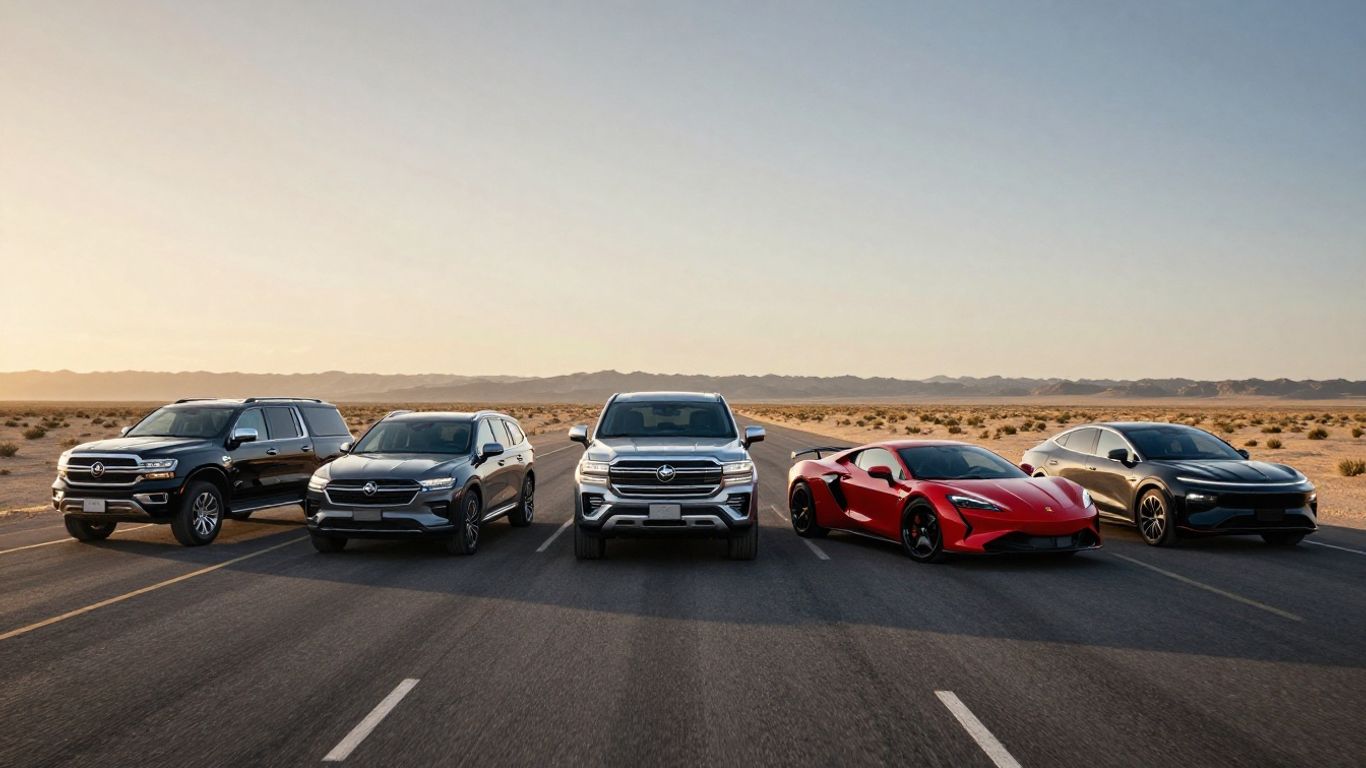
Cadillac Escalade, Celestiq and CT5-V Blackwing
Cadillac’s range offers three different ways to think about a flagship. The Escalade is a large luxury SUV with considerable presence and passenger-carrying ability. The Celestiq represents an ultra-premium electric direction, while the CT5-V Blackwing expresses the performance side of the marque through a powerful sports saloon.
They are not direct substitutes. A buyer choosing between them would first need to decide whether the priority is space, exclusivity or driving involvement. That is a recurring theme across this article: the word flagship can describe a family of ambitions rather than one universally correct vehicle.
Chevrolet Suburban, Corvette and Silverado
Chevrolet’s Suburban is one of the clearest examples of a large SUV acting as a practical flagship. Its size and carrying capacity give it a different character from the Corvette, whose role is built around sports-car performance and design. The Silverado occupies another major American category, using the full-size pick-up format as a statement of capability and utility.
These vehicles demonstrate how regional tastes shape the flagship label. A European reader may instinctively think of an executive saloon, but a manufacturer with a strong SUV or truck heritage may express its highest ambitions through a much larger and more functional vehicle.
Ford Expedition, Mustang and F-150
Ford’s Expedition is a large SUV designed around space and family use, while the F-150 is a landmark pick-up name with a strong practical and commercial identity. Mustang provides the performance and emotional counterpoint, carrying a heritage that reaches well beyond its individual trim levels.
Taken together, they form a useful map of Ford’s upper range rather than a simple top-to-bottom order. The right choice depends on whether the buyer values passenger room, load-carrying ability or the feel of a dedicated performance car.
Tesla Model S, Model X and Cybertruck
Tesla’s Model S and Model X have traditionally occupied premium positions within its car range, with the former taking a saloon approach and the latter using an SUV format. Cybertruck brings a radically different interpretation of a flagship, centred on the visual and functional language of a large electric pick-up.
The comparison is a reminder that electric flagships do not have to follow conventional luxury-car shapes. Their appeal may come from range, acceleration, cabin technology, utility or a distinctive design. Those priorities should be tested against everyday use rather than assumed from the badge.
Flagship models from luxury and performance manufacturers
Luxury and performance manufacturers tend to define their flagships through craftsmanship, exclusivity or driving character. Their most expensive models may be built in small numbers, and a specialist SUV can be as central to the business as a coupé or grand tourer. This makes simple comparisons with mainstream manufacturers misleading.
For these brands, the flagship often acts as a concentrated expression of a particular tradition. It may favour rear-seat serenity, dramatic acceleration, hand-finished detail or the ability to travel comfortably at speed.
Rolls-Royce Phantom, Bentley Flying Spur and Maybach S-Class
The Rolls-Royce Phantom, Bentley Flying Spur and Mercedes-Maybach S-Class are built around formal luxury, fine materials and a high level of passenger comfort. The Phantom has an especially strong association with ceremonial presence, the Flying Spur combines Bentley’s grand touring identity with four-door usability, and the Maybach S-Class extends the S-Class idea into a more exclusive format.
Their appeal is not primarily about practicality or value. Buyers are paying for presentation, personalisation, quietness and the feeling that the vehicle has been designed around the occupants. Those qualities make them flagships even when their sales volumes remain modest.
Ferrari Purosangue, Lamborghini Revuelto and Aston Martin DB12
The Ferrari Purosangue brings a high-riding, four-door interpretation to a manufacturer better known for sports cars. Lamborghini Revuelto represents the brand’s exotic performance tradition, while the Aston Martin DB12 follows the grand tourer path, combining dramatic styling with a car intended for fast, comfortable travel.
Each is a flagship through emotion and engineering rather than sheer size. For this group, acceleration, steering, sound, seating position and visual drama can matter more than rear-seat accommodation or a low monthly running cost.
McLaren 750S, Maserati Quattroporte and Lotus Emeya
The McLaren 750S is a focused performance car, while the Maserati Quattroporte has long represented the Italian luxury-saloon interpretation. Lotus Emeya adds a modern electric grand-tourer angle, showing how performance manufacturers are adapting the flagship idea to battery power.
Their differences are substantial, but all require a buyer to think beyond a specification sheet. A car that is exceptional on a circuit may be less suitable for daily commuting, while a powerful electric grand tourer may be easier to use regularly but require careful planning around charging.
Jeep Grand Wagoneer and other specialist SUV flagships
The Jeep Grand Wagoneer illustrates how a specialist SUV manufacturer can use size, cabin space and premium presentation to define its top model. Similar examples from other makers may focus on off-road ability, towing, luxury accommodation or a combination of the three.
SUV flagships are often the most versatile vehicles in a range, but versatility does not make them universally sensible. Their size can complicate parking, their weight can affect efficiency and their tyres or suspension may be costly to replace. A flagship should be judged in the environment where it will actually be used.
Comparing flagship models by manufacturer
A comparison of flagship models by manufacturer is most useful when it separates the badge from the buyer’s needs. A top model can be brilliant yet unsuitable for a particular commute, family or budget. Looking at several practical measures makes the decision clearer and reduces the temptation to choose on prestige alone.
There is no single winner across every category. A saloon may offer a calmer rear cabin, an SUV may provide easier access and more luggage room, and a sports car may deliver a level of engagement that neither can match.
Interior quality, comfort and passenger space
Interior quality is more than the number of screens or the appearance of the dashboard. Materials, seat design, visibility, noise suppression and the ease of using the controls all shape how a flagship feels after a long journey. Rear-seat space matters particularly in executive cars, while SUVs add useful height and flexible loading arrangements.
It is worth sitting in the vehicle rather than relying on photographs. Check whether the driving position suits you, whether child seats fit, and whether the boot remains useful with all passengers aboard. Everyday comfort matters more than a prestigious equipment list if the car is used for ordinary journeys.
Performance, handling and driving character
Performance can mean very different things. A luxury saloon may prioritise smooth acceleration and stable motorway manners, while a sports car may communicate more through steering, braking and cornering response. A large SUV can offer impressive pace but still feel quite different from a lower, lighter car.
A test drive should cover the roads you use most often. Look for ride quality over poor surfaces, confidence at higher speeds and ease in tight spaces, not only the headline acceleration figure. The best flagship is the one whose character feels natural to its owner.
Powertrains, electrification and driving range
Flagship buyers can now choose between petrol, diesel in some markets, hybrid systems and fully electric power. Electric vehicles tend to offer quiet running and immediate response, while hybrids can reduce the need to rely on public charging for every longer trip. Conventional engines may still suit drivers who regularly cover long distances in areas with limited charging access.
The following comparison gives a broad framework rather than a fixed ranking, since specifications and UK availability change over time.
| Flagship type | Main strength | Questions to ask |
|---|---|---|
| Executive saloon | Quiet comfort and rear-seat refinement | Is the lower seating position practical? |
| Luxury SUV | Space, access and commanding visibility | Can you manage its size and running costs? |
| Sports car | Performance and emotional appeal | Will it work for your normal journeys? |
| Electric flagship | Quiet power and reduced tailpipe emissions | Where will you charge on longer trips? |
The table highlights why powertrain choice cannot be separated from body style. A vehicle with impressive official range may still be inconvenient if home charging is unavailable, while a petrol car may be straightforward to refuel but more expensive to run in heavy urban traffic.
Technology, safety systems and software support
Flagship models often introduce advanced driver assistance, large displays, connected services and more configurable cabin systems. The useful question is not how many features are listed, but whether they are intuitive and supported over the period you expect to own the car. Some systems reduce fatigue, while others can distract if their menus are unnecessarily complicated.
Safety equipment also needs careful interpretation. Check the exact UK specification, the standard equipment on the chosen trim and how the assistance systems behave in real traffic. A vehicle’s reputation should never replace a close look at the actual car being offered.
Price, ownership costs and resale value
The purchase price is only one part of flagship ownership. Insurance, tyres, servicing, energy or fuel, road tax, depreciation and finance costs can alter the overall picture substantially. Large wheels, complex suspension and high-output powertrains may increase costs even when the initial deal looks attractive.
Leasing can make the monthly commitment easier to understand because the contract sets out a payment, term and mileage allowance. First Flexi Lease presents flexible car leasing with fixed monthly costs, while the exact suitability of any arrangement still depends on the vehicle, mileage and contract terms. Buyers should read those terms carefully and compare the full package, not just the advertised monthly figure.
How to choose the right flagship model
Choosing a flagship should begin with the life the vehicle needs to fit, not with the badge that has the greatest status. Think about passengers, annual mileage, parking, luggage, charging and the roads you actually drive. A clear shortlist is usually more valuable than an unlimited search through every premium manufacturer.
The same practical discipline applies whether you intend to buy, finance or lease. First Flexi Lease’s approach to fixed-package vehicle leasing is relevant for drivers who want a defined monthly arrangement, although the right model and terms still need to match their circumstances.
Matching the model to your driving needs
Start by writing down the non-negotiables. A daily motorway user may value quietness and supportive seats, while a family may need easy access and a genuinely useful boot. Someone who drives mainly on small urban roads may find a compact premium model more comfortable to live with than a much larger flagship SUV.
A short list can be built around four practical checks:
- How many people and how much luggage must it carry?
- What distance will it cover in a typical week?
- Where will it be parked and, if electric, charged?
- Which monthly or annual running costs are acceptable?
These questions keep the search grounded. They also make it easier to compare a conventional range-topper with a smaller vehicle that may deliver a better fit for everyday use.
Choosing between a saloon, SUV and sports car
Choose a saloon when long-distance comfort, low-speed refinement and a composed driving position matter most. An SUV may be preferable for easier entry, extra ground clearance, a taller cabin or flexible passenger space. A sports car is the specialist choice for buyers who place driving enjoyment and design above carrying capacity.
There is no need to treat one body style as the definitive flagship. The best option depends on how often the car will carry passengers, how much space is needed and whether the owner wants the vehicle to feel calm, versatile or exciting every time it moves.
Deciding between petrol, hybrid and electric power
Petrol remains straightforward for drivers who want quick refuelling and regularly travel beyond familiar routes. A hybrid can be a useful middle ground, especially where urban and short-distance driving form a large part of the week. An electric flagship may suit drivers with dependable home or workplace charging who value quiet progress and immediate performance.
Consider the whole routine rather than a single official figure. Check the charging network on regular routes, the time available for charging and the likely energy cost. For any powertrain, the contract mileage should reflect genuine use, since exceeding an allowance can affect the overall cost.
Checking availability, servicing and UK-market specifications
A model appearing in an international list does not guarantee that it is sold new in the UK. Confirm the current trim, engine or battery options, safety equipment, warranty, delivery timing and servicing arrangements. Imported or low-volume vehicles may require more planning, particularly if specialist support is limited.
For a simpler route into a new vehicle, readers can get a quote and ask for the current terms rather than assuming an old advert still applies. First Flexi Lease covers cars and vans through flexible arrangements, but every offer should be checked for its exact mileage, duration, inclusions and availability before making a decision.
Conclusion
Flagship models come in many forms, from executive saloons and luxury SUVs to electric grand tourers and focused sports cars. The most convincing choice is not necessarily the largest or most expensive; it is the vehicle whose comfort, performance, powertrain and ownership arrangements suit the way you live and drive.
Frequently asked questions
What is a flagship model?
Is a flagship always the most expensive car from a manufacturer?
Can an SUV be a manufacturer’s flagship?
Are electric cars becoming flagship models?
Why do some manufacturers have more than one flagship?
What should I compare when choosing between flagship cars?
Is leasing suitable for a flagship model?
Reviewed by
Billy Lang, Director
FCA Registration No: 835008
Keep reading
Related guides
Vehicle guides
Are 1.0-litre turbo engines any good?
How three-cylinder 1.0 turbo engines manage the pace of a bigger engine on small-car running costs, where they struggle, and which ones have proven themselves.
Read guideVehicle guides
Audi A1: Perfect First Car
The Audi A1 can make a polished, manageable first car, but the right example matters more than the badge. Think carefully about insurance, servicing, space and the condition of any used model before committing. Compact dimensions make the A1 comfortable in town and easier to park. The premium cabin and technology are appealing,…
Read guideVehicle guides
Are Alfa Romeo Cars Reliable?
Whether Alfa Romeo cars are reliable depends less on the badge alone and more on the model, engine, age and care it has received. Newer Alfa Romeo models can be enjoyable and dependable when serviced correctly. Electrical warnings, battery issues and wear to suspension components are common ownership concerns. A complete service history…
Read guideReady when you are
Put the reading into practice.
A soft credit check via Creditsafe takes minutes. It does not normally affect your credit score the same way as a full lending application — and you get an honest answer either way.
Request a Flexi Quote
Quick form. Tell us which flexi stock you are interested in and we'll call you back the same day.
