
Iconic WWI Vehicles
The First World War began with armies that still relied heavily on horses, foot soldiers and railway timetables. Within months, artillery, machine guns, barbed wire and trenches had made movement across open ground extraordinarily…
The battlefield that shaped WWI vehicles
The First World War began with armies that still relied heavily on horses, foot soldiers and railway timetables. Within months, artillery, machine guns, barbed wire and trenches had made movement across open ground extraordinarily dangerous. The resulting deadlock created a problem that engineers tried to solve with engines, armour and mechanical traction. The history of WWI vehicles is therefore also a history of adapting industry to an unforgiving battlefield.
Trench warfare and the need for mobility
Trenches were not simply ditches waiting to be crossed. They were linked defensive systems, protected by wire, machine-gun positions, dugouts and artillery. Mud could swallow wheels, while shell holes turned apparently open ground into a series of hidden obstacles. A vehicle intended to help the infantry had to cross ground that ordinary lorries and cars could not manage.
The tank emerged from this specific need. Its tracks spread weight more effectively than narrow wheels and allowed it to crawl over broken earth. Early machines were slow and uncomfortable, but their value lay in reaching places where soldiers, horses and conventional vehicles became exposed or stuck.
Industrial production and mechanised warfare
Mechanisation depended on more than a clever design. Engines, steel plate, tracks, tyres, fuel, spare parts and trained mechanics all had to be produced and delivered in quantity. Britain and France were able to commit substantial industrial resources to tanks, aircraft, lorries and artillery tractors, while Germany’s priorities and shortages limited its own tank programme.
The war also encouraged practical improvisation. Civilian cars became staff vehicles and ambulances; commercial lorries carried ammunition; tractors were adapted for heavy guns. A useful machine did not always begin life as a military vehicle. Often, it was the available chassis, fitted with whatever equipment the army could obtain.
Protection, firepower and reliability trade-offs
Designers constantly balanced competing demands. More armour offered protection but increased weight. Larger guns improved firepower but needed stronger mounts and reduced internal space. Bigger engines promised speed, yet consumed more fuel and could be harder to maintain in field conditions. The most successful WWI vehicles were rarely perfect; they were workable compromises.
A tank might survive rifle fire yet fail because its cooling system overheated. An armoured car might be fast on a road but helpless in a flooded shell crater. Aircraft needed enough power to carry weapons and fuel while remaining light enough to climb and manoeuvre. Reliability mattered as much as innovation, especially when a breakdown could leave a crew stranded under fire.
Why many experimental designs failed
The war created a rush of proposals, from enormous landships to small, lightly protected carriers. Some were defeated by manufacturing difficulties, others by poor visibility, weak engines or an inability to cross the terrain for which they had been designed. A prototype could look impressive in a yard and still prove useless once mud, smoke and enemy fire entered the calculation.
This experimental culture was not wasted. Failed vehicles revealed what armies actually needed: manageable dimensions, dependable power, sensible crew arrangements and a way to coordinate with infantry and artillery. The lessons were often clearer in defeat than in success, and they helped narrow the path towards more practical military vehicles.
Tanks that broke the trench deadlock
Tanks were among the most recognisable WWI vehicles because they addressed the central problem of the Western Front directly. Their early appearances were uneven, with breakdowns and mechanical failures alongside moments of genuine surprise. Even so, the basic idea was persuasive: a tracked vehicle could carry protection and weapons across ground that stopped conventional transport.
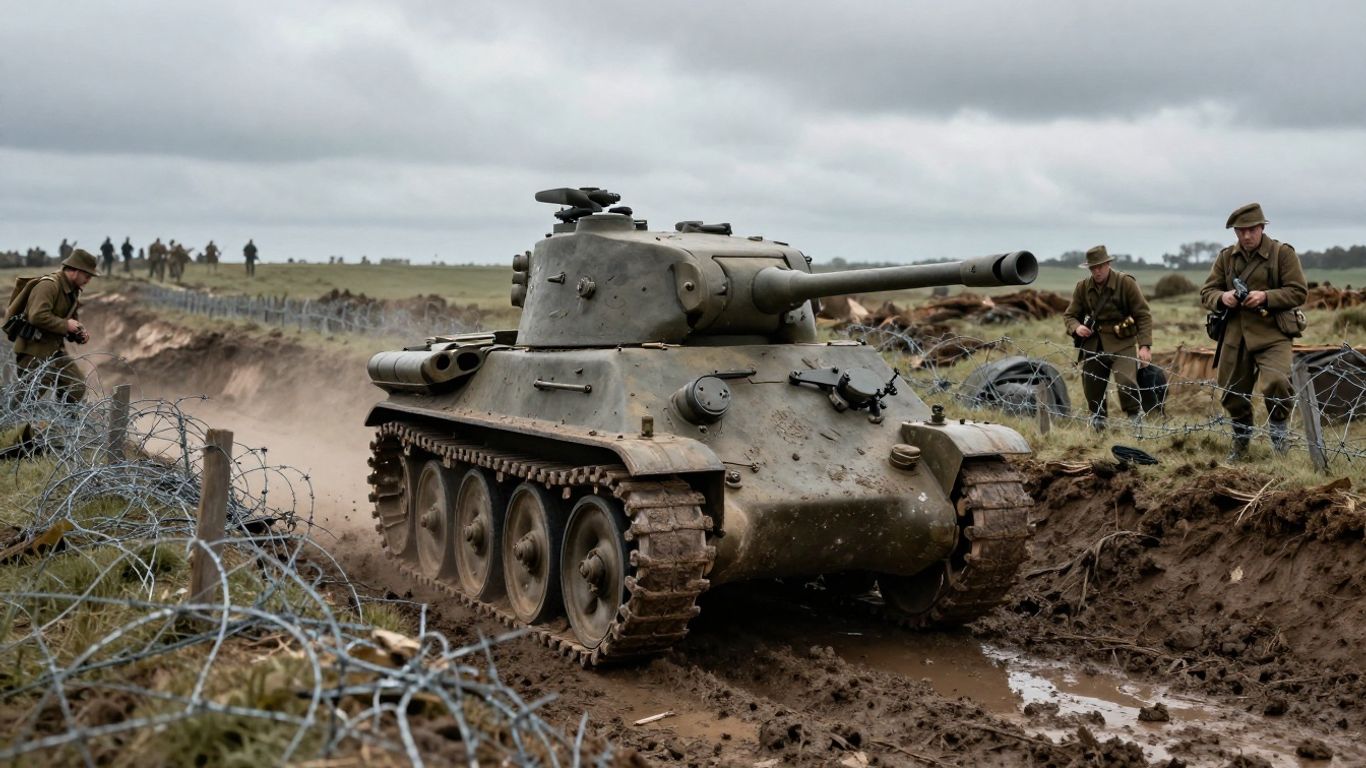
The machines that followed differed greatly in size, speed and layout. Some were heavy assault vehicles designed to cross trenches; others were lighter and more mobile. Together they formed the first rough vocabulary of armoured warfare.
The British Mark I and its pioneering design
The British Mark I entered battle in 1916 as a large rhomboid-shaped tank with tracks running around the entire hull. This arrangement helped it climb over trenches and broken ground, although it made the vehicle slow, difficult to steer and physically demanding for its crew. Male versions carried heavier guns, while female versions concentrated on machine guns.
The tank’s appearance could unsettle troops who had never seen anything like it. Yet its battlefield performance depended on far more than shock. Many vehicles broke down before reaching their objectives, and crews faced heat, fumes, noise and poor visibility inside the hull. The Mark I was pioneering precisely because it demonstrated both the possibilities and the costs of tracked armour.
The faster Whippet and its battlefield role
The Medium Mark A Whippet was smaller and quicker than the heavy British tanks. It used a different arrangement of engines and steering controls, allowing it to move around the battlefield with greater freedom. Rather than being built mainly to crush through the strongest trench obstacles, it could exploit openings, support advances and threaten exposed positions.
Its speed made it useful once the front began to move. The Whippet could travel farther and respond more quickly than the lumbering heavy tanks, though it remained vulnerable to artillery and mechanical trouble. Its role hinted at a future in which tanks would not all perform the same task.
Germany’s A7V and limited tank programme
Germany developed the A7V as a heavy tracked vehicle, but only a small number were completed. It was tall, heavily crewed and difficult to produce, and Germany did not pursue tank construction on the same scale as Britain and France. German forces also captured and reused Allied tanks where possible.
The A7V’s limited deployment meant that it never became the defining German answer to the tank question. Its existence nevertheless shows how national strategy shaped vehicle development. Industrial capacity, battlefield doctrine and access to resources mattered as much as engineering ambition.
The Renault FT and the modern tank layout
The French Renault FT was a compact light tank with a rotating turret, a front-mounted crew compartment and the engine at the rear. This arrangement separated driving, fighting and propulsion more logically than many earlier designs. It became one of the most influential layouts in tank history.
The FT was not built to do everything. Its small size limited crew space and carrying capacity, while its protection and speed were modest. But the turret gave its weapon a wide field of fire, and the overall design was easier to produce and operate than the giant trench-crossing machines. A comprehensive combat vehicle list places the FT alongside the many experimental and production designs that marked this turning point.
Armoured cars on roads and open terrain
Armoured cars were among the earliest successful military adaptations of the motor car. They combined a wheeled chassis with steel protection and machine guns, giving patrols a degree of mobility and resistance to small-arms fire. Their usefulness depended heavily on geography, however. Firm roads, dry plains and long-distance patrol routes suited them far better than the cratered mud of the Western Front.
They became particularly valuable in places where the war was more mobile, including parts of the Middle East, Africa and the Eastern Front. Their story is a reminder that there was no single battlefield experience in 1914–18.
The Rolls-Royce Armoured Car and imperial patrols
The Rolls-Royce Armoured Car was based on a high-quality motor-car chassis and fitted with armour and a turret-mounted machine gun. Its road speed, range and mechanical quality made it suitable for patrol and security work across the British Empire. In desert and semi-arid settings, it could cover distances that would have been exhausting for foot patrols.
These vehicles were not trench breakers. Their value came from movement, observation and the ability to appear quickly where a slower force might take much longer to arrive. They also needed fuel, maintenance and usable routes, so their freedom was never absolute.
Austin armoured cars on the Eastern Front
Austin armoured cars were produced for Russia and saw service in the more fluid fighting of the Eastern Front. Their wheeled design made sense across broad stretches of road and open country, where armoured cars could manoeuvre, raid and support mobile formations. They were often associated with crews who valued speed and initiative.
Their effectiveness still depended on the condition of the ground. A vehicle that could travel rapidly on a hard road might lose its advantage in soft fields or deep mud. Eastern Front operations therefore revealed both the promise and the limits of wheeled armour.
Lanchester armoured cars and naval engineering
The Lanchester armoured car drew on a substantial car chassis and was associated with naval use and overseas service. Its construction reflected an attempt to give a road vehicle enough strength for military work without abandoning the speed that made armoured cars attractive. It could carry a crew and weapons while remaining more mobile than a tracked tank.
Naval engineers and sailors were involved in several early armoured vehicle projects, bringing experience with engines, steel and mechanical systems. That cross-service involvement helped expand the range of ideas being tested during the war.
Why armoured cars struggled in muddy trench country
Wheels concentrate pressure on a smaller contact area than tracks, and steering a wheeled vehicle through shell holes is difficult even before enemy fire is considered. Barbed wire, parapets and deep trenches could stop an armoured car outright. Its armour also added weight, increasing the chance of bogging down.
For this reason, armoured cars often served away from the most static parts of the Western Front. A history of WW1 armoured cars helps place these machines in their wider setting: they were early examples of protected mobility, but not universal substitutes for tanks.
Aircraft that transformed reconnaissance and combat
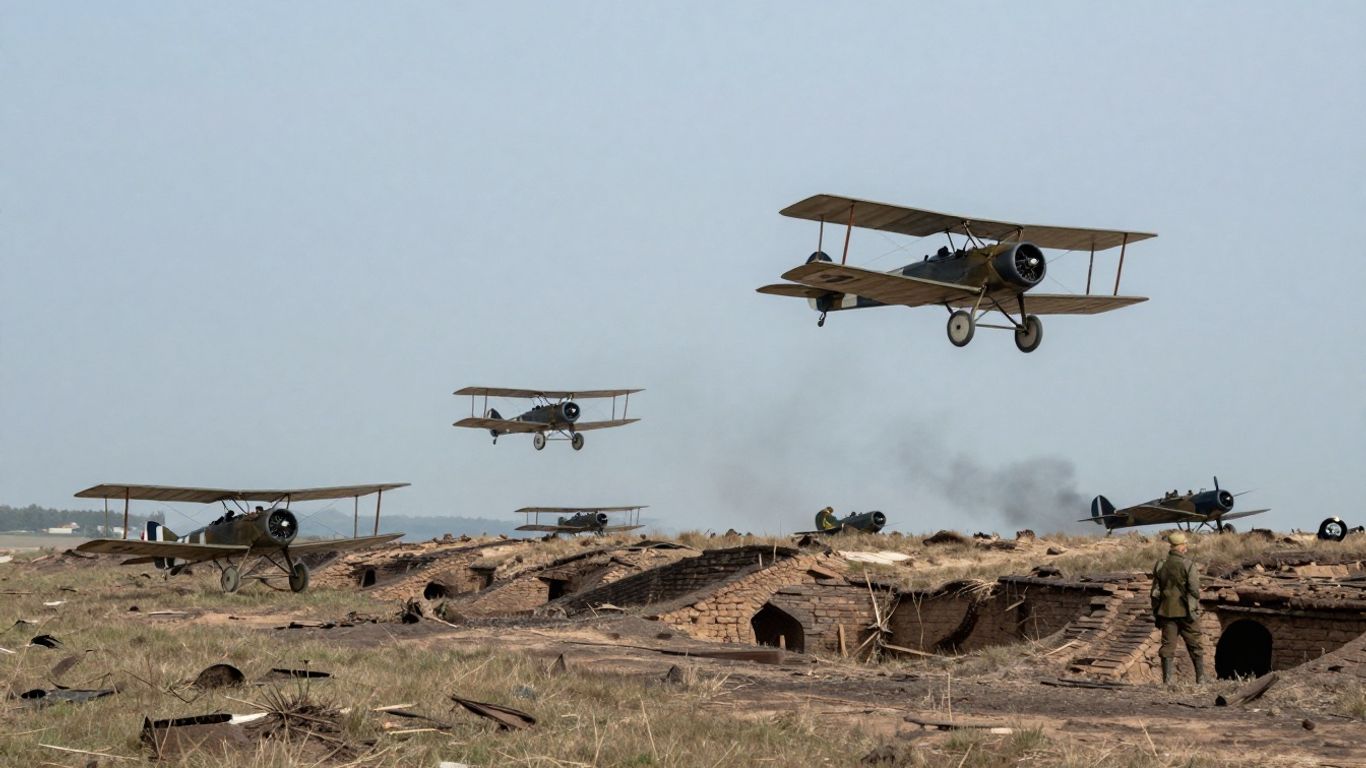
Aircraft changed the war before they became reliable fighting machines. At first, their most important task was observation: locating enemy batteries, watching troop movements and correcting artillery fire. Cameras and wireless communication gradually made aerial reconnaissance more precise, while opposing air forces tried to deny one another access to the sky.
The aeroplane was fragile, open to the weather and limited by engine performance. Nevertheless, it created a new layer of the battlefield, one that extended above trenches and made concealment much harder.
The Fokker Eindecker and synchronised machine guns
The Fokker Eindecker became famous for its forward-firing machine gun synchronised to the propeller. This allowed a pilot to aim the aircraft itself while firing through the propeller arc, a major change from earlier arrangements. The resulting advantage helped create a period of German air superiority often remembered as the “Fokker Scourge”.
The Eindecker was not an especially elegant aeroplane by later standards, but its armament system mattered enormously. It showed that aerial combat would depend on combining pilot control, engine power, visibility and weapon placement rather than simply carrying a gun into the air.
The Sopwith Camel and close-range dogfighting
The Sopwith Camel was a British single-seat fighter with twin machine guns mounted in front of the cockpit. Its concentrated weight around the front made it responsive in a turn, which suited close dogfighting. It could be demanding to fly, particularly for inexperienced pilots, but skilled aviators used its manoeuvrability to great effect.
Fighter combat was usually short, tense and difficult to observe from the ground. Pilots had limited instruments, unreliable engines and little protection. Survival depended on judgement as much as on the aircraft’s published performance.
The Royal Aircraft Factory SE5a and air superiority
The SE5a was valued for its speed, stability and strong construction. It offered a steadier gun platform than some more agile fighters and could operate effectively at higher altitude. These characteristics made it useful for escort, interception and patrol work.
Air superiority was never simply a matter of having the fastest fighter. Squadrons needed mechanics, fuel, replacement aircraft, trained pilots and information from observers. The SE5a’s importance lay partly in how it fitted into that larger system.
Gotha bombers and the emergence of strategic bombing
Gotha bombers carried out long-range raids against targets away from the immediate front. Their operations brought the possibility of bombing civilian and industrial centres into public life, even though the aircraft were limited by weather, navigation and defensive interception.
The raids were modest by later standards, but their psychological and political effect was substantial. Governments had to think about air defence, warning systems and the vulnerability of cities. Aircraft had become more than battlefield scouts; they were now instruments of pressure across national borders.
Naval and amphibious vehicles of WWI
At sea, mechanisation had already transformed warfare before 1914, but the conflict accelerated the process. Large warships carried heavy guns over immense distances, submarines attacked commerce beneath the surface, and small fast craft brought speed to coastal fighting. Naval vehicles operated in a different environment from tanks and lorries, yet they faced the same questions of range, protection, firepower and reliability.
The sea also connected theatres of war. Fuel, troops and raw materials moved by ship, making naval control central to national survival.
U-boats and unrestricted submarine warfare
German U-boats used stealth and submerged movement to attack merchant shipping and warships. Their most controversial role came during campaigns of unrestricted submarine warfare, when vessels could be attacked without the conventional restrictions associated with surface raiding. The submarine threatened supply lines while forcing opponents to develop convoys, escorts and new detection methods.
Operating underwater imposed severe constraints. Crews endured cramped conditions, limited visibility and the constant danger of depth charges. A submarine’s effectiveness depended on patience, intelligence and careful management of battery power and air.
Dreadnoughts and the Battle of Jutland
Dreadnought battleships represented the concentration of naval power in heavily armoured, heavily armed surface ships. Their steam turbines provided considerable speed, while large-calibre guns allowed them to engage at long range. At the Battle of Jutland in 1916, the British and German fleets fought the largest fleet action of the war.
The battle did not produce a simple tactical conclusion. Losses were heavy, but the German High Seas Fleet did not break Britain’s command of the sea. Jutland showed that naval power was measured not only by ships destroyed but also by what a fleet could still do afterwards.
Motor torpedo boats and coastal attacks
Motor torpedo boats were small, quick craft designed for surprise attacks against larger ships and coastal targets. Their speed allowed them to approach at night or in poor visibility, launch torpedoes and withdraw before a heavier opponent could respond effectively.
They were vulnerable once detected. Light construction offered little protection, and rough water could reduce their speed or accuracy. Still, the boats demonstrated how a relatively small vehicle could threaten a much larger warship through concealment and concentrated firepower.
Zeppelins and long-range reconnaissance
Zeppelins offered long endurance and the ability to travel far over sea and land. They were used for reconnaissance and bombing, particularly early in the war, when their height and range made interception difficult. Crews could survey broad areas that were beyond the practical reach of many aeroplanes.
Their weaknesses became clearer as aircraft, anti-aircraft guns and incendiary ammunition improved. Large, hydrogen-filled airships were difficult to hide and could burn rapidly when hit. The Zeppelin’s career therefore illustrates how quickly countermeasures could alter the value of a vehicle.
Transport vehicles behind the front line
Combat machines attracted the headlines, but transport vehicles kept armies functioning. Ammunition, food, fuel, medical equipment and replacement parts had to reach units in quantities that horses alone could not always manage. Trucks, motorcycles, ambulances and tractors formed a practical network behind the trenches.
This supporting fleet was often less glamorous than a tank or fighter. Its failure, however, could halt an offensive just as surely as enemy action. The war made logistics visible as a mechanical problem.
Trucks and the movement of troops and supplies
Lorries moved supplies from railheads towards the front, often along roads damaged by shelling and heavy traffic. They carried everything from ammunition to engineering materials, and some were adapted for troop movement. Their usefulness depended on standardised parts, fuel supply and a steady flow of drivers and mechanics.
The transition from horse transport was gradual rather than complete. Animals remained vital where roads ended or terrain became too soft, but motor lorries increasingly handled the long hauls. The contrast is captured in the wider account of six WWI vehicles, which considers how civilian machines were adapted for military work.
When comparing the roles of transport vehicles, a simple distinction helps separate battlefield mobility from the practical work of supply:
| Vehicle type | Main advantage | Common limitation | Typical supporting role |
|---|---|---|---|
| Lorry | Carrying capacity | Needed usable roads | Ammunition and general supply |
| Ambulance | Faster casualty movement | Vulnerable and restricted by terrain | Evacuation to medical stations |
| Motorcycle | Speed and low running cost | Little carrying capacity | Messages and liaison |
| Tractor | Pulling power | Slow road speed | Heavy guns and equipment |
The table also shows why armies needed a mixed fleet. No single vehicle could carry the load, cross every surface and communicate with every unit. Logistics worked through combination.
Ambulances and the changing practice of battlefield medicine
Motor ambulances reduced the time needed to move wounded soldiers from aid posts to dressing stations and hospitals. Their enclosed bodies offered some protection from weather, while suspension and interior fittings were adapted for carrying patients. They operated within a growing evacuation chain rather than acting as isolated rescue vehicles.
Medical transport changed clinical practice as well. Faster movement made triage more organised and helped specialists receive patients sooner, although roads, shellfire and congestion could still delay evacuation. The ambulance became an essential link between battlefield treatment and hospital care.
Motorcycles and despatch riders
Motorcycles gave armies a relatively light way to move messages between headquarters, artillery positions and forward units. Despatch riders could use narrow tracks and avoid some of the congestion affecting larger vehicles. Their work was dangerous, particularly when routes were exposed or poorly marked.
A motorcycle carried little compared with a lorry, but communication did not require a large payload. Its value was speed and independence. Radios were developing, yet reliable human couriers remained important throughout the war.
Tractors, railway vehicles and heavy artillery transport
Heavy artillery demanded powerful means of movement. Steam tractors and petrol-powered artillery tractors could tow guns that were too heavy for ordinary teams or motorcars. Railways, meanwhile, moved enormous quantities over long distances before specialised vehicles and crews took over near the front.
The arrangement was layered: rail for strategic movement, lorries for distribution and tractors for the final heavy pull. Modern leasing is obviously a very different subject, but the same practical question remains familiar to businesses choosing working transport. Volkswagen Transporter leasing is presented as a flexible option for a modern diesel van, while First Flexi Lease focuses on fixed-package vehicle access rather than bespoke complexity.
The legacy of WWI vehicles
The mechanical experiments of 1914–18 did not create modern warfare in a single stroke. Horses remained important, many machines were unreliable and battlefield coordination was often poor. Yet the war established that engines could carry protection, weapons, messages, patients and supplies into places where traditional methods struggled.
Its legacy can be seen in design, organisation and doctrine. The vehicle was no longer merely a convenient replacement for a horse; it was becoming part of an integrated military system.
From improvised machines to specialised military vehicles
Early adaptations often used civilian chassis, commercial engines and armour added under pressure. By the end of the war, manufacturers and armies had a clearer sense of specialised requirements. Tanks needed appropriate tracks and crew layouts, aircraft needed integrated weapons, and transport fleets needed dependable maintenance arrangements.
This change was gradual, but it was profound. A military vehicle increasingly began life with a defined role rather than being converted after purchase. That distinction influenced procurement for decades.
How the Renault FT influenced later tank design
The Renault FT’s turret, front fighting compartment and rear engine layout became a powerful template. Later tanks varied in size, armour and armament, but many retained the basic logic of separating driving, fighting and propulsion. The design was compact enough to be produced in quantity and adaptable enough to serve in different roles.
Its influence was not based on perfection. The FT was slow and lightly armoured compared with later vehicles. Its importance came from making a practical arrangement understandable, repeatable and easier to develop.
The shift towards combined arms warfare
The war showed that tanks could not succeed alone. Infantry had to protect them from enemy soldiers, artillery had to suppress defensive positions, engineers had to clear obstacles and transport units had to keep fuel and ammunition moving. Aircraft added observation and attack from above.
Combined arms warfare grew from this interdependence. A tank was most useful when it formed part of a plan linking several capabilities. The same lesson applied at sea and in the air: performance depended on crews, communication, maintenance and supply as much as on the machine itself.
Where to see surviving and restored WWI vehicles
Surviving WWI vehicles are uncommon because many were scrapped, abandoned or dismantled for parts. Museums and private collections preserve tanks, trucks, artillery pieces, aircraft replicas and restored engines, allowing visitors to appreciate their scale and mechanical compromises. Demonstrations can be especially revealing: a vehicle that looks static behind glass becomes much more understandable when its engine starts.
Some collections also run living-history events and restoration displays. A restored vehicle collection offers one example of how early military machines can be maintained and shown in working condition, although individual exhibits and event schedules naturally vary.
Conclusion
WWI vehicles grew out of a desperate need to move, observe, protect and strike across an industrial battlefield. Tanks, armoured cars, aircraft, ships and support transport each solved part of the problem, while their failures taught engineers and commanders what mechanised warfare demanded. Their lasting importance lies not only in their iconic shapes, but in the systems of logistics and cooperation that made them useful.
Explore Modern Vehicle Options
The machinery of 1914–18 reminds us that the right vehicle depends on the job, the route and the practical terms around it. For modern cars and vans in Exeter and the South West, First Flexi Lease offers fixed monthly rentals, transparent terms and flexible contracts from six to 48 months.
Frequently asked questions
What were the main types of WWI vehicles?
Why were tanks developed during the First World War?
Which country used the first tanks in battle?
What made the Renault FT significant?
Were armoured cars useful in trench warfare?
How did aircraft affect WWI battles?
Did motor vehicles replace horses during WWI?
Reviewed by
Billy Lang, Director
FCA Registration No: 835008
Keep reading
Related guides
Driving life
Brake Checking
Brake checking is deliberate, unnecessary braking intended to unsettle or endanger a following driver. It is different from braking normally for traffic, hazards or road conditions. Brake checking can cause a serious rear-end collision. A rear driver is not automatically solely responsible for every crash. Deliberate braking, tailgating and road rage may all…
Read guideDriving life
Road Trip Tips for Drivers with Leased Vehicles
A leased car can be a practical choice for a long drive, provided you understand the agreement and prepare properly. Check mileage, travel-area and overseas rules before departure. Calculate the whole journey, including detours and normal driving. Confirm insurance, breakdown assistance and permitted drivers. Prepare the car and protect it from avoidable damage.…
Read guideDriving life
Backseat Drivers
Backseat driving can come from concern, anxiety or habit, but repeated interference can make a journey less safe and more tense. Helpful guidance is brief, specific and focused on genuine safety risks. Constant criticism or competing directions can distract the driver. Agreeing expectations before a journey usually prevents arguments. Passengers can help with…
Read guideReady when you are
Put the reading into practice.
A soft credit check via Creditsafe takes minutes. It does not normally affect your credit score the same way as a full lending application — and you get an honest answer either way.
Request a Flexi Quote
Quick form. Tell us which flexi stock you are interested in and we'll call you back the same day.
